
Introduction to 2025 Tech Innovations 🌐
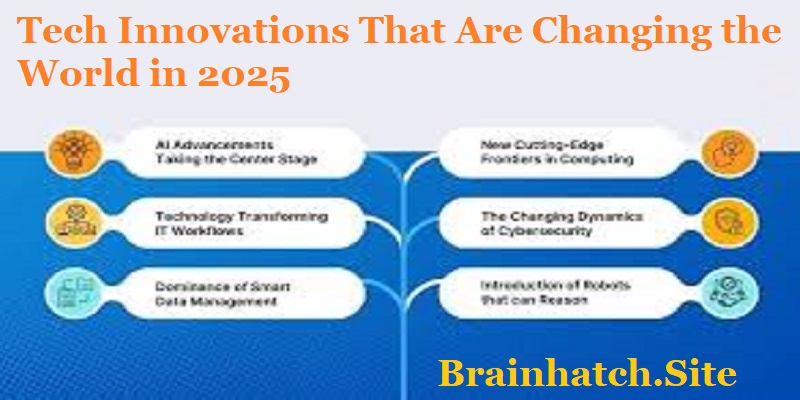
The year 2025 is witnessing groundbreaking technological advancements that are reshaping industries, economies, and daily life. From artificial intelligence to renewable energy solutions, innovations are addressing complex challenges and creating new opportunities. These technologies are not just futuristic concepts—they are actively influencing how people work, communicate, and interact with the world. Understanding these innovations is crucial for businesses, professionals, and individuals who want to stay ahead of trends. By exploring the most impactful technologies, we gain insight into how the world is evolving and how creativity, knowledge, and innovation drive progress in the modern era.
Artificial Intelligence and Machine Learning 🤖
Artificial intelligence (AI) and machine learning are leading the technological revolution in 2025. AI algorithms can process massive amounts of data to predict trends, automate complex tasks, and provide personalized solutions. Machine learning models are improving efficiency in healthcare, finance, logistics, and more by identifying patterns that humans may miss. In daily life, AI powers smart assistants, autonomous vehicles, and personalized recommendations. As these technologies advance, ethical AI and responsible deployment have become critical considerations. By harnessing AI and machine learning, organizations and individuals can make smarter decisions, enhance productivity, and create innovative solutions to pressing challenges.
Next-Generation Renewable Energy Solutions 🌞
Renewable energy technologies are evolving rapidly in 2025, making sustainable power more efficient and accessible. Solar panels, wind turbines, and energy storage systems are now more affordable and capable of meeting growing global demands. Innovations in smart grids and energy management allow for optimized distribution and reduced waste. Companies and governments are investing in renewable infrastructure, reducing dependence on fossil fuels, and combating climate change. Advances in bioenergy, wave energy, and hydrogen fuel also contribute to a cleaner, greener future. By integrating knowledge and innovation, renewable energy is transforming the way we power homes, industries, and cities worldwide.
5G and Next-Level Connectivity 📶
The rollout of 5G networks is revolutionizing communication and connectivity in 2025. With faster speeds, lower latency, and higher reliability, 5G enables new possibilities in augmented reality, virtual reality, autonomous vehicles, and smart cities. Businesses can deploy advanced IoT systems, enhancing efficiency, safety, and decision-making. Remote work, online learning, and telemedicine are more seamless thanks to improved bandwidth and connectivity. 5G’s impact extends to entertainment, gaming, and media consumption, offering immersive experiences. By leveraging next-level connectivity, individuals and organizations can innovate in ways that were previously impossible, creating a more connected and technologically advanced world.
Autonomous Vehicles and Smart Transportation 🚗
Autonomous vehicles are reshaping transportation in 2025. Self-driving cars, trucks, and drones are improving safety, efficiency, and logistics. Smart transportation systems integrate AI, IoT, and data analytics to optimize traffic flow and reduce emissions. Ride-sharing and autonomous delivery services are becoming more common, transforming urban mobility. These innovations are not limited to private vehicles—public transport systems are incorporating automation and predictive analytics to enhance convenience and reliability. By combining technology and creative problem-solving, autonomous transportation is reducing accidents, saving time, and offering sustainable solutions for commuting and goods delivery worldwide.
Healthcare Innovations and Biotechnology 🧬
Healthcare is undergoing a technological revolution in 2025, with innovations improving diagnostics, treatments, and patient care. Biotechnology advances, including CRISPR and gene editing, allow for personalized medicine and targeted therapies. Wearable devices and AI-powered diagnostics provide real-time monitoring and predictive health insights. Telemedicine continues to expand access to healthcare, especially in remote areas. These innovations are transforming the medical field, making healthcare more efficient, precise, and patient-centric. By integrating knowledge-driven technology with creativity in medical research, the healthcare industry is developing solutions that save lives, prevent diseases, and enhance overall well-being globally.
Augmented Reality and Virtual Reality Experiences 🕶️
Augmented reality (AR) and virtual reality (VR) are redefining experiences in entertainment, education, and industry. In 2025, these immersive technologies allow interactive learning, remote collaboration, and virtual tourism. Businesses use AR for marketing, product design, and customer engagement, while VR enhances training simulations in healthcare, aviation, and manufacturing. Mixed reality applications are merging physical and digital worlds, creating seamless and interactive experiences. By combining creativity and technology, AR and VR are expanding the boundaries of human experience, offering new ways to visualize, interact, and innovate in both personal and professional contexts worldwide.
Advanced Robotics and Automation 🤖
Robotics and automation are transforming industries, from manufacturing to agriculture. In 2025, robots are more intelligent, versatile, and collaborative, capable of performing complex tasks alongside humans. Automation improves productivity, precision, and safety, while reducing operational costs. In logistics, warehouse robotics optimize supply chains, and in agriculture, automated systems enhance crop management. Robotics also plays a role in healthcare, providing surgical assistance and rehabilitation support. By integrating robotics with AI and IoT, industries can innovate processes, increase efficiency, and focus human talent on strategic, creative problem-solving, shaping a future where technology and human ingenuity coexist harmoniously.
Blockchain and Decentralized Finance (DeFi) 💰
Blockchain technology is revolutionizing finance, supply chains, and digital security. In 2025, decentralized finance (DeFi) platforms enable peer-to-peer transactions, lending, and asset management without intermediaries. Smart contracts automate agreements securely, reducing costs and risks. Blockchain ensures transparency, traceability, and data integrity across industries. Beyond finance, blockchain is applied in healthcare, logistics, voting systems, and intellectual property protection. These innovations enhance trust, efficiency, and accessibility. By combining knowledge, creativity, and technological innovation, blockchain is empowering individuals and organizations to participate in a secure, decentralized digital economy with unprecedented opportunities for innovation.
Quantum Computing and Advanced Problem Solving ⚛️
Quantum computing is emerging as a revolutionary technology in 2025. Unlike classical computers, quantum computers leverage quantum bits (qubits) to process information at unprecedented speeds. This capability enables solving complex problems in cryptography, drug discovery, material science, and optimization tasks. Industries are exploring quantum algorithms for predictive analytics and modeling simulations that were previously impossible. While still in early stages, quantum computing holds the potential to redefine problem-solving in science and technology. By combining creative thinking, technical knowledge, and quantum principles, innovators can unlock solutions to challenges that were once considered unsolvable.
Space Technology and Exploration 🚀
Space exploration is advancing rapidly in 2025 with private companies and governments driving innovation. Satellite technology, reusable rockets, and deep-space missions are expanding our understanding of the universe. These innovations improve global communication, Earth observation, and climate monitoring. Space tourism and commercial exploration are also becoming more viable, creating new economic opportunities. Advanced propulsion systems, AI-assisted navigation, and robotics are enabling safer and more efficient missions. By combining knowledge, creativity, and cutting-edge technology, humanity is pushing the boundaries of exploration, opening new frontiers for research, commerce, and international collaboration in space.
The Future of Tech Innovation 🌟
Technology in 2025 is transforming every aspect of life, from healthcare to transportation, finance, and entertainment. Innovations driven by AI, robotics, renewable energy, quantum computing, and AR/VR are creating new possibilities for problem-solving and creativity. Staying informed about emerging trends and embracing technological adoption ensures individuals and organizations remain competitive and forward-thinking. By integrating knowledge with imagination and experimentation, we can harness technology to improve quality of life, address global challenges, and create opportunities for sustainable growth. The future belongs to those who innovate, adapt, and creatively leverage technology to make a lasting impact.